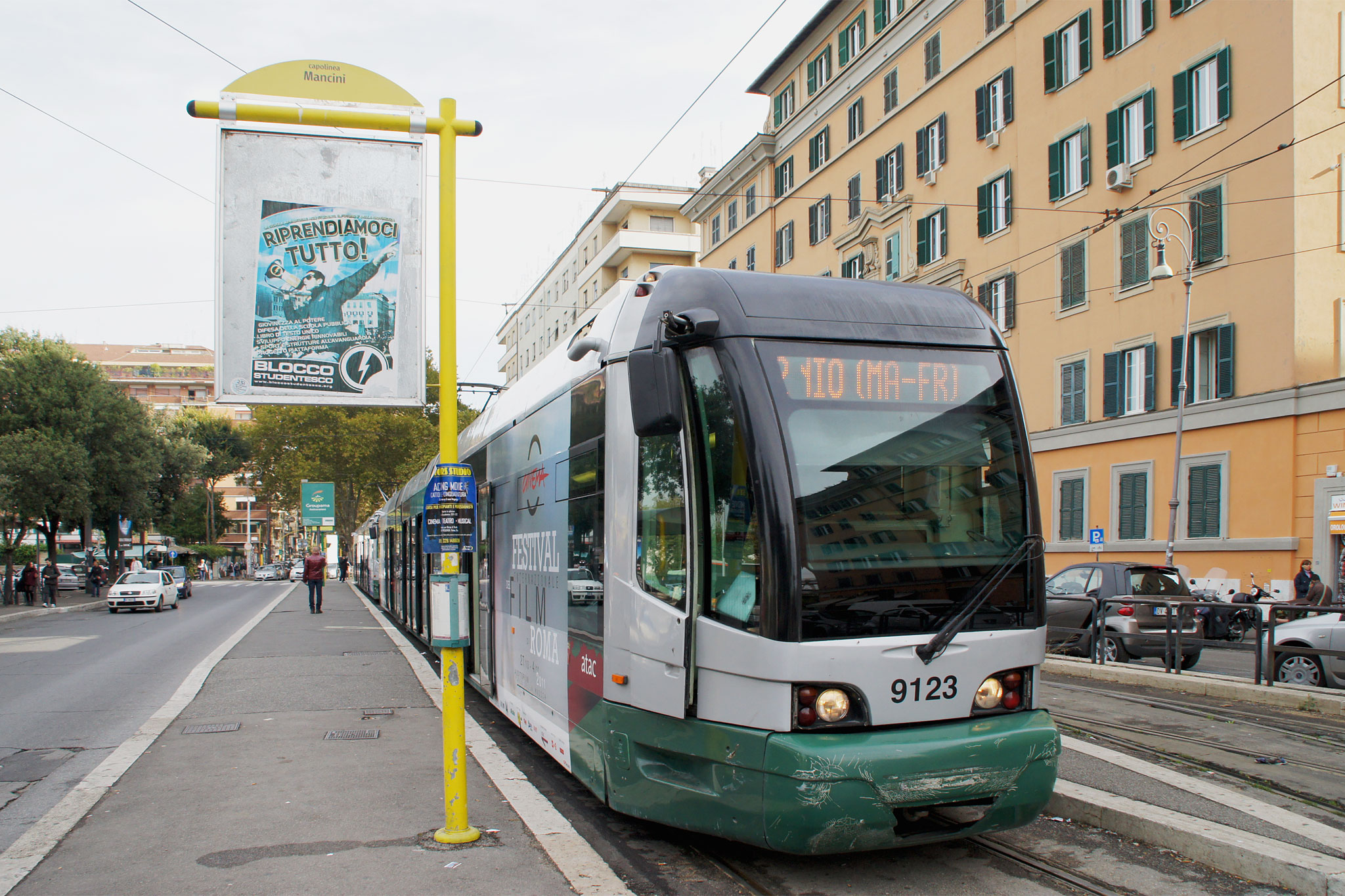
The following is a list of tram/streetcar (including heritage trams/heritage streetcars), or light rail systems with their track length, track gauge, electrification system.
The vast majority of tram systems use 1,435 mm (4 ft 8 1⁄2 in) standard gauge. Generally, standard gauge is the standard for every brand new system (except for the former Soviet Union), even in places where there is another gauge for the heavy rail. Metre gauge is mainly present in some old, continuously operating systems in Central Europe. Russian gauge is used only in the former Soviet Union.
The electrification system for the old systems is generally 600 V DC while the more recent systems use 750 V DC. Some old systems upgraded to 750 V in recent years (mostly in Germany) while some systems (e.g. Romania) downgraded the voltage to 600 V to use the second-hand vehicles coming from the upgraded German networks. Few systems are partially or wholly catenary-free, with APS and ACR systems or using a pure internal power source as battery or ultracapacitors. Very few vintage systems are horse-drawn tram or cable car. For references for the figures, see each system's page.
Systems in operation
Note: Overhead line electrification unless specified differently. All systems use direct current
Track gauge of defunct systems
Narrow gauge
Standard gauge
Broad gauge
See also
References
External links
- Hilton, George W.; Due, John Fitzgerald (1 January 2000). The Electric Interurban Railways in America. Stanford University Press. ISBN 978-0-8047-4014-2. Retrieved 10 June 2014.
Worst of all, not all city systems were built to the standard American and European gauge of 4'-81⁄2". Pittsburgh and most other Pennsylvania cities used 5'-21⁄2", which became known as the Pennsylvania trolley gauge. Cincinnati used 5'-21⁄2", Philadelphia 5'-21⁄4", Columbus 5'-2", Altoona 5'-3", Louisville and Camden 5'-0", Canton and Pueblo 4'-0", Denver, Tacoma, and Los Angeles 3'-6", Toronto an odd 4'-107⁄8", and Baltimore a vast 5'-41⁄2".