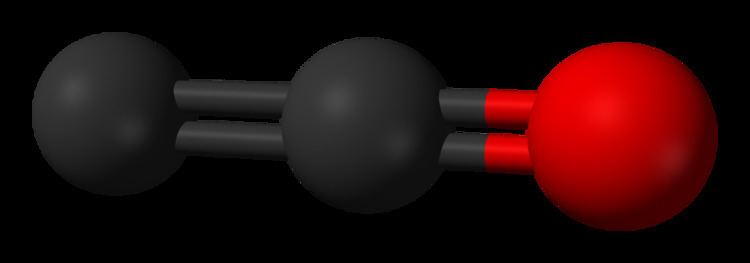
Dicarbon monoxide (C2O) is a molecule that contains two carbon atoms and one oxygen atom. It is a linear molecule that, because of its simplicity, is of interest in a variety of areas. It is, however, so extremely reactive that it is not encountered in everyday life. It is classified as a carbene, cumulene and an oxocarbon.
Occurrence
Dicarbon monoxide is a product of the photolysis of carbon suboxide:
- C3O2 → CO C2O
It is stable enough to observe reactions with NO and NO2.
Called ketenylidene in organometallic chemistry, it is a ligand observed in metal carbonyl clusters, e.g. [OC2Co3(CO)9] . Ketenylidenes are proposed as intermediates in the chain growth mechanism of the Fischer-Tropsch Process, which converts carbon monoxide and hydrogen to hydrocarbon fuels.
The organophosphorus compound (C6H5)3PCCO (CAS# 15596-07-3) contains the C2O functionality. Sometimes called Bestmann's Ylide, it is a yellow solid.
References